Gail-Anderson Cat

Gail-Anderson Cat

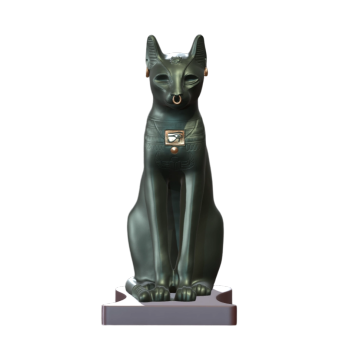
Gail-Anderson Cat is a bronze statue depicting the image of the goddess Buster. The goddess is usually portrayed as a female figure of the head of the cat, or directly in the form of a cat. The main center of worship of the goddess Bast is located in Bubatis, in the Nile Delta. As a maternal goddess, Buster is gentle and kind, in contrast to the more aggressive lioness god, Sehmet. The statue dates back to the late dynasty of ancient Egypt, around 600 BC. Major Robert Grenville Gail-Anderson donated the statue to the British Museum in 1939 and named it in his honor.
Hindu Heritage Krishna (Krishna) Bronze Statue

Hindu Heritage Krishna (Krishna) Bronze Statue

This is a bronze statue of Krishna (Krishna) from the southern Indian state of Tamil Nadu. According to the Indian epic Mahabharata (Mahabharata), Krishna is one of the incarnations of Vishnu. The statue was created between the 13th and 14th centuries AD and is currently in the collection of the Museum of World Cultural Ethnology in Barcelona. This statue reflects the high integration of exquisite metal craftsmanship and religious art in Tamil Nadu, and also bears witness to the prosperity of South Indian culture and belief in the 13th and 14th centuries.
Bronze statue of "Wild Boar"

Bronze statue of "Wild Boar"

This "wild boar" statue is a plaster model of an ancient statue in the collection of the Museum of the Academy of Fine Arts in Krakow. It is a replica of an ancient statue in the Uffizi Gallery in Florence. This marble boar statue is from the Roman period and is a copy of a lost Hellenistic original, probably by artists from around the famous sculptor Lisipos (Lysippos). This Roman boar statue was presented by Pope Pius IV to Cosimo I de Medici, Duke of Tuscany.
Lužánky Park Tolerance Statue in Brno

Lužánky Park Tolerance Statue in Brno

is an important work of art located in the Lužánky Park in Brno, Czech Republic. Originally in 1892 as part of the Joseph II Sculpture Group, located in Moravian Square. In 1918, the sculptures were removed, and the trade and tolerance statues were relocated to Denis's warehouse until 2005, when they were relocated in Lužánky Park.. Lužánky Park is not only the largest park in Brno, but also the oldest municipal park in the Czech Republic, with numerous sculptures, statues and fountains, an important place for citizens' leisure and cultural activities. The statue of tolerance has also become a symbol of Brno's cultural heritage.
Bust of Joseph Sumerick

Bust of Joseph Sumerick

He is a world-class Czech electrician, one of the founders of the Electrical Engineering School of Brno Technical University, and served as a professor and president of the school from 1912 to 1913. His field of research was not limited to electrotechnics, but also to acoustics and music, especially the tuning of keyboard instruments. He consulted with the famous composer Leios Janáczek on tuning issues and contributed to the "Dictionary of Music. His academic achievements have been widely recognized, including an honorary doctorate from the Czech Technical University in Prague. He has made a great contribution to the development of electrical technology in the Czech Republic and has published about 68 professional papers in the field of electrical engineering.
Memorial statue of President Thomas Garrig Masaryk in Brno

Memorial statue of President Thomas Garrig Masaryk in Brno

It was founded in honor of the first president of Czechoslovakia. The history can be traced back to August 29, 1937, when it was unveiled in the Pohuni section of the 1st of May Square. The bronze bust was created by Czech technical lawyer Vaclav Heinec Maher, while the base is made of Silesian granite and designed by A.Hladík. Masaryk's signature is engraved on the cylinder of the statue, and the surrounding garden is edited by the City Garden Authority. The statue is a tribute to President Masaryk and a symbol of Czech national renewal and democratic values. His contributions have an important place in Czech history and culture.
Bohuslav Martinu Bronze Head

Bohuslav Martinu Bronze Head

He was one of the most prolific Czech composers of the 20th century. His work incorporates French and Czech influences and is known for his unique style and technique. He began to study violin at the age of 7 and studied at the Prague Conservatory of Music. Later, he was expelled and began to study on his own. During the First World War, he lived in the countryside and began to compose music. In 1923, he went to Paris for further studies, where he lived until the 1940 invasion of France by Nazi Germany, after which he went into exile in the United States. In the United States, Martinu became a star composer and taught at Princeton University and many other universities. His music is known for its energy, charm and originality.
Rhino-JaroslavRóna

Rhino-JaroslavRóna

JaroslavRóna is a multi-talented Czech artist whose identities include sculptor, painter, actor, educator and writer. It is known for its sculptural works, which cover a wide range from public art to private collections. The artistic style is deeply influenced by primitive art and expressionism, and has created many striking sculptures and paintings. His works are famous for their strong visual impact and profound emotional expression. His sculptures often take the characters as the theme, and convey strong emotions and profound social comments through exaggeration and deformation.
Konopiště Castle Hunter Statue

Konopiště Castle Hunter Statue

Is a manifestation of the hunting passion of Archduke Franz Ferdinand. He is the last owner of the castle, an avid hunter whose hunting diary records more than 250,000 hunted kills, while the castle displays about 100,000 animal trophies. The hunter statue is not only a display of the archduke's personal hobbies, but also a reflection of the noble hunting culture of that era. The interior of the castle was decorated with a large number of weapons and intricate armor, further emphasizing Archduke Franz Ferdinand's love of hunting and military. It became an important part of the history and culture of Konopiště Castle.
The Old Centaur and the Love God Eros
The Old Centaur and the Love God Eros

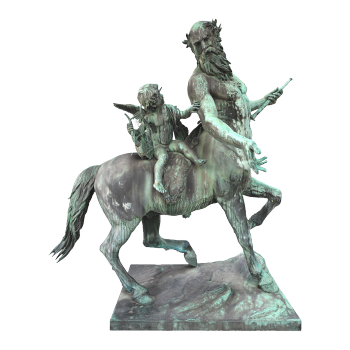
The bronze statues of the centaur and the riding goddess Eros, located in front of the Academy of Fine Arts in Vienna, were created in 1892. This statue represents the characteristics of old age through the image of an old centaur and the riding of Eros, and is a typical example of the combination of art and mythology.
Friedrich Schiller Memorial

Friedrich Schiller Memorial

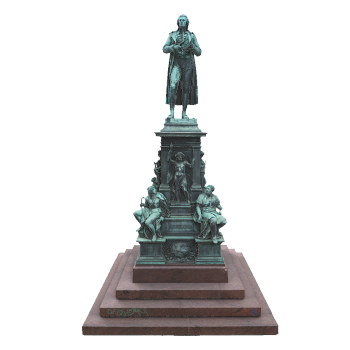
This bronze statue is the Friedrich Schiller Memorial on Schiller Square in Vienna's First District. There are four seated figures at the four corners of the pedestal, derived from Schiller's poem "The Song of the Bell", representing children (sitting on their mother's lap), the elderly, young travelers, and cast iron workers. Franz P ö nninger and Josef R ö lich created this monument at the K.K. Art Foundry.
Standing Christ

Standing Christ

This model is a standing Christ, with his right hand leaning against a low wall. This individual character was originally part of a group of characters. It may depict the scene of Christ and an adulterous woman, or the scene of Christ and a Samaritan woman by the well. Now collected in the Heiligenkreuz Monastery Museum
Western Zhou bronze lamp holder

Western Zhou bronze lamp holder

The "Western Zhou Bronze Man Lamp Holder" is a Chinese cultural relic from the 5th to 4th centuries BC, currently housed in the Minneapolis Museum of Art in the United States. This cultural relic is made of bronze and embedded with metal. This small and exquisite figure statue has outstretched hands, and its curled fingers form a socket that was originally used to insert the pole of an oil lamp. During the Shang and Western Zhou dynasties (1600-771 BC), bronze figures were very rare, but now several bronze figures have been excavated from Zhou tombs in the late Warring States period as lamp sockets.
Gallic knight Roman

Gallic knight Roman

The Gallic Knight Roman "is an artwork created by Emmanuel Fremit (1824-1910). This is a sculpture depicting a Gallic knight It was created in the 1860s for the National Archaeological Museum of Saint Germain in France. It is a bronze sculpture cast by Barbedienne Foundry in the early 20th century. Its dimensions are 36.5 centimeters high, 9.5 centimeters long, and 9.6 centimeters wide. This sculpture is now housed in the Mus é e d'Orsay in France. Emmanuel Fr é met is a French sculptor known for his animal sculptures.
Gallic knights

Gallic knights

The 'Gallic Knight' is an artwork created by Emmanuel Fremit (1824-1910). This is a sculpture depicting a Gallic knight It was created in the 1860s for the National Archaeological Museum of Saint Germain in France. It is a bronze sculpture cast by Barbedienne Foundry in the early 20th century. Its dimensions are 36.5 centimeters high, 9.5 centimeters long, and 9.6 centimeters wide. This sculpture is now housed in the Mus é e d'Orsay in France. Emmanuel Fr é met is a French sculptor known for his animal sculptures.
Egyptian female statue

Egyptian female statue

It usually refers to the female images of ancient Egypt, who held important positions in art, society, and religious life. In ancient Egyptian art, female images were often depicted as graceful and dignified postures, reflecting the respect and noble status of women in ancient Egyptian society. These images can be sculptures, murals, or paintings on pottery, depicting the daily lives, clothing, jewelry, and roles of ancient Egyptian women in their families and society. It also plays an important role in religious ceremonies, sometimes depicted as worshippers of gods or individuals directly associated with gods.
White Bone Top Chicken Bronze Statue

White Bone Top Chicken Bronze Statue

Foulque is a replica of a bronze sculpture, the original of which is housed in the Fine Arts Museum in Dijon, France. This replica was made of resin material by Rmn-P (Louvre and Osay Museum Picture Agency) and belongs to the studio of the art museum. The dimensions of this artwork are a height of 27 centimeters, a width of 18.5 centimeters, and a depth of 9.5 centimeters.
Charles Francois Jacques' work "Crocodile and Snake Fight - Belgium"
Charles Francois Jacques' work "Crocodile and Snake Fight - Belgium"

It is a famous artwork, also known as the 'Belgian Struggle', created by Belgian artist Charles Fran ç ois Jean Baptiste Rave in 1848 as a sculpture. It depicts a fierce battle between a huge crocodile and a snake in the water. Their bodies intertwine to form a dynamic and dramatic picture. The crocodile opened its huge mouth, trying to bite the snake, while the snake tangled around the crocodile, trying to survive. It is also a part of Belgian cultural heritage.
Pavlov Monument

Pavlov Monument

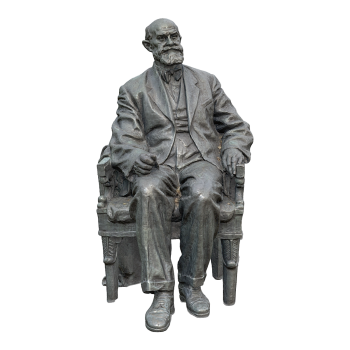
The Pavlov Monument is located in St. Petersburg, Russia and was built to commemorate the great Russian physiologist Ivan Pavlov. A pioneering physiologist and psychologist whose research has had a significant impact on understanding the development of conditioned reflexes and behavioral psychology. He proposed Pavlov's law through experimental research on dogs, which states the relationship between conditioned stimuli and conditioned reflexes. It is one of the iconic attractions of St. Petersburg, symbolizing the brilliant achievements of Russian science and Pavlov's important position in the field of physiology.
The Renaissance statue at the French monument in Paris

The Renaissance statue at the French monument in Paris

This monument once represented Saint Joan of Arc, but later changed and was named after the French monument Renaissance, located at the top of Ileaux Cygnes next to the Pont Bir Hakeim bridge in Paris. Although this equestrian statue in Paris was originally created by Danish artist Holger Wedekinch in 1930 to represent Joan of Arc, the statue you see today was cast in Malakov in 1948 and donated to the city of Paris.
Bronze Statue of a Boxer at the National Museum of Rome
Bronze Statue of a Boxer at the National Museum of Rome

The statue depicts a boxer sitting down and resting for a moment in the midst of a fierce boxing match. He is an elderly boxer who has been through boxing matches for a long time. His image appears tired, and from his movements and expressions, he seems to lack confidence in whether he can win. However, he still shows great concern for the game. He exposes his solid muscles all over his body, although he is strong, he has a strong sense of not following his heart. Sculptor Apollonius displayed a high degree of realism in this work, with the human body's movements and bulging muscles conforming to the anatomy of the human body. Not only is the external form realistic, but the internal mental state is also extremely vivid, full of humanity and life.
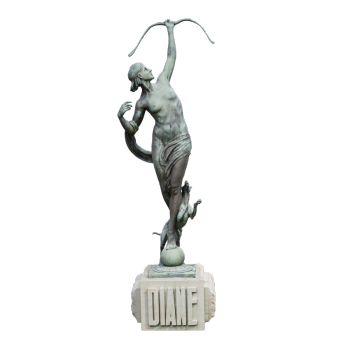
Bronze Statue of Diana Artemis

Bronze Statue of Diana Artemis

Diana, the Roman goddess. She absorbed most of the mythology of Artemis, equivalent to her Greek mythology. The goddess in charge of hunting and the moon.
The statue of the Amazon female knight riding on horseback

The statue of the Amazon female knight riding on horseback

The statue is located in Berlin's Tierra Garden. It was made of bronze by Berlin sculptor Louis Tuaillon in 1895, but was not installed here until 1906.
Shang Dynasty Sanxingdui bronze ware "Shang Bronze Man Head"

Shang Dynasty Sanxingdui bronze ware "Shang Bronze Man Head"

This cultural relic is a bronze ware from the Shang Dynasty, with a human head of Fang Yi. It comes in two types: flat topped and round topped, with large or vertical ears and perforated earlobes. Garlic nose, wide mouth, and thick neck. Wrap the hair backwards and add braids or hair accessories to the back of the head. It is currently collected in the Sanxingdui Museum.
1 2 Next